Industry Insight
Climate Crisis: Renewable Solutions for Our Collective Future
Why Canada needs a low-carbon transition, and what policy and clean tech are doing about it, and how rooftop solar fits for Ontario homes.
Why Canada needs a low-carbon transition, and what policy and clean tech are doing about it, and how rooftop solar fits for Ontario homes.
Climate change is one of the defining issues of our time, and it is a conversation that reaches from Canadian farm fields to the halls of government. For homeowners in Ontario, it also raises a practical question: what can I actually do at home? This article looks at why many scientists and policy makers call for a low-carbon transition, what Canada has been doing about it, and where rooftop solar fits in.
The Intergovernmental Panel on Climate Change (IPCC) has concluded in its assessment reports that human activity is the main driver of recent warming, and has described atmospheric carbon dioxide levels as higher than at any time in at least hundreds of thousands of years. United Nations Secretary-General Antonio Guterres called one IPCC report a "code red for humanity." The scientific consensus is that limiting warming to the temperature ranges set out in the Paris Agreement requires steady cuts in emissions from electricity, transportation, buildings and industry.
A low-carbon future for Canada would draw on solar, wind, hydro, biofuels and other clean sources, along with better efficiency. With sound policy, education and investment, Canada has the resources to be a leader in clean energy, and solar will be one important piece of that mix.
A common worry is that moving away from conventional energy will cost jobs, especially alongside the rise of automation and artificial intelligence. Supporters of a "just transition" argue the opposite: building clean infrastructure, installing solar, retrofitting buildings and expanding electric transportation create skilled work in local communities. Solar is a good example. Every rooftop system needs design, permitting, electrical work, installation and ongoing service, much of it done close to home.
Several federal initiatives have been aimed at lowering emissions. Here is a snapshot of the examples that were highlighted when this article was first written in 2021:
Update (2026): the Greener Homes Grant stopped accepting new applicants in January 2024, and many of the programs and targets above have been revised since this article was written. For what is available to Ontario homeowners today, see our incentives guide. You can also read official background on federal home energy programs at Natural Resources Canada's home energy efficiency pages.
Climate action is often described as both global and local. National policy sets the direction, but a lot of the change happens one building at a time. Homes use energy for heating, cooling, lighting and increasingly for charging vehicles. Making that energy cleaner, and producing some of it on your own roof, is one of the most direct steps a homeowner can take.
In Ontario, a rooftop array can offset a meaningful share of your yearly electricity use. With net metering, extra power you produce on sunny days can earn credits for use later, and a battery storage system can add backup power and let you use more of your own solar energy.
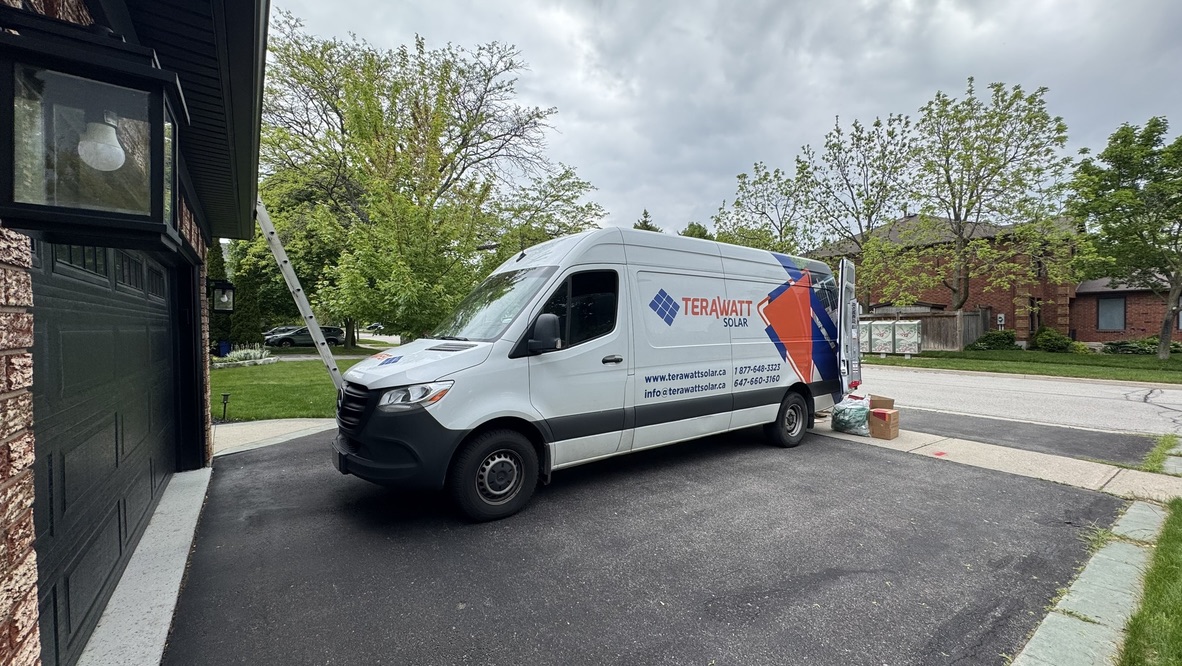
Terawatt Solar designs and installs residential solar and commercial solar systems across the Greater Toronto Area and Ontario. Our ESA-licensed crews are our own employees, not subcontractors, so the people who design your system are accountable for how it is installed. Every project begins with a free site assessment, where we look at your roof, shading, electrical panel and energy use and explain what a system could realistically deliver.
Ready to see what solar could do for your home? Book a free site assessment with our in-house team, or call (877) 648-3323.
Solar panels generate electricity without burning fuel, so each kilowatt hour you produce at home is a kilowatt hour you do not need to draw from the grid at that moment. The size of the benefit depends on how your system is designed and how much you use.
The original Canada Greener Homes Grant is closed to new applicants. Programs change often, so check our incentives page for the current picture.